Silica Safety For Employers & Supervisors
Silica exposure is a known workplace hazard across many industries. Employers and supervisors play a key role in planning controls, supporting workers, and preventing harm. This page helps you quickly understand where to start, then connects you to practical guidance, tools, and resources.
For background on silica health risks and exposure, visit Silica Basics.
Start Here: Managing Silica on Your Site
- Materials: Do you use concrete, stone, brick, drywall, or sand?
- Tasks: Do jobs create dust (cutting, grinding, drilling, demolition)?
- Controls: Are dust controls in place and working?
- Training: Do workers understand the risks and controls?
- PPE: Is respiratory protection assigned and used properly?
Respirable crystalline silica can lodge deep in the lungs, where it cannot be removed. If silica dust is present, employers are responsible for assessing the level of exposure and putting appropriate controls in place.
Your Responsibilities
Employers have a legal responsibility to take reasonable precautions to protect workers from respirable crystalline silica, including providing appropriate training, supervision, tools and equipment. Understanding where silica may be present on your site, and the levels of exposure your workers will face, is the first step in planning practical controls.
1. Identify Risk
Start by reviewing materials and tasks on your site. If work involves concrete, stone, brick, mortar, tile, drywall, asphalt, sand/soil, or engineered stone—and tasks like cutting, grinding, drilling, sanding, crushing, or demolition—silica dust is likely a risk.
High-frequency or high-exposure tasks should include air quality testing to verify that controls are effective and that the appropriate level of protection is in place.
It is the employer’s responsibility to ensure that workers are not exposed to airborne concentrations of crystalline silica that exceed the Threshold Limit Value (TLV®), which is an 8-hour time-weighted average of 0.025 mg/m3 (respirable fraction).
2. Apply Hierarchy of Controls
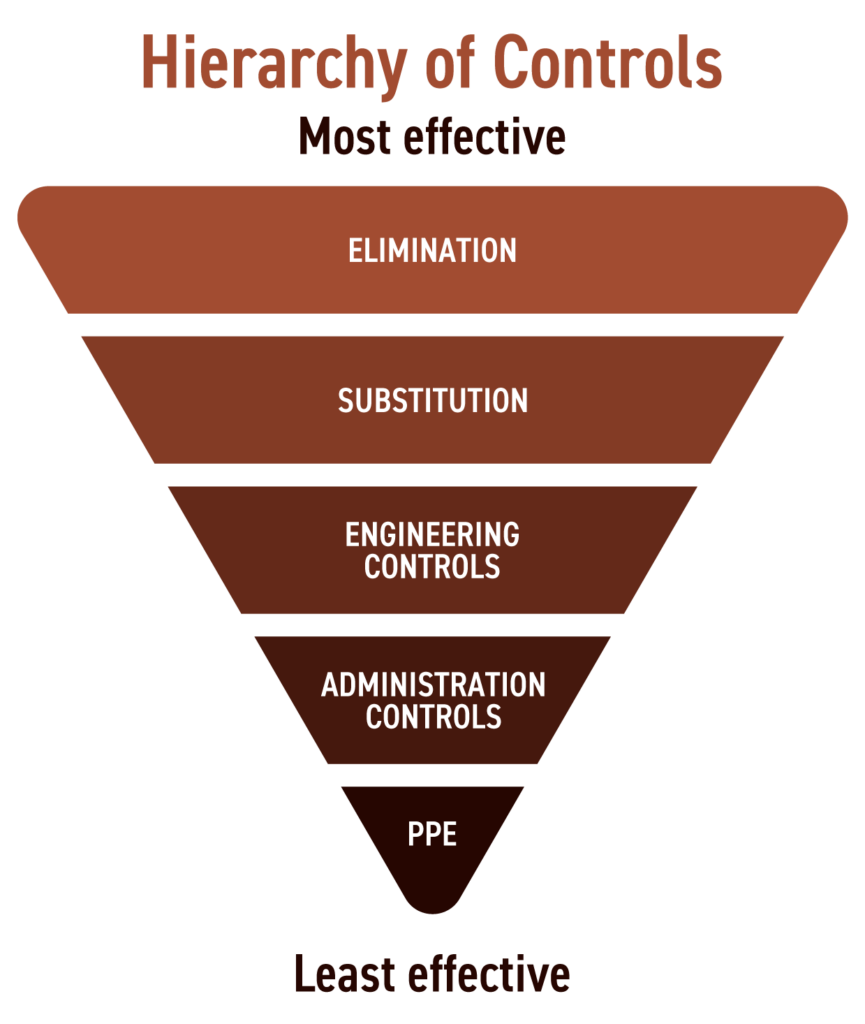
Use the hierarchy of controls to prevent exposure, starting with the most effective measures before relying on PPE. Controls should be selected based on the tasks and risks on your site and put in place in a practical, planned way. Start with the most effective options that fit your work and build improvements over time as needed.
- Eliminate / Substitute: remove silica-dust sources where possible or use lower-silica materials/methods.
- Engineering controls: reduce dust at the source using wet methods, ventilation/dust collection, isolation/enclosures, and tool/process improvements.
- Administrative controls: training, safe work procedures, restricted access/limited time in dusty areas, scheduling/rotation, maintenance programs and air quality monitoring at regular intervals.
- Housekeeping & hygiene: wet cleanup or HEPA-filtered vacuuming, no dry sweeping/compressed air; hygiene practices to prevent take-home exposure.
- PPE (last layer): respirators and other PPE when required for the task, used as part of overall controls.
3. Confirm Controls Are Working
Check whether the controls in place are effectively keeping dust low. Where uncertainty remains, further evaluation, including exposure assessment or monitoring, can be guided by qualified occupational hygiene support.
Training and regular communication are essential to preventing silica exposure on site.
Training should cover:
- Where crystalline silica may be present and which tasks create dust.
- Health risks and why prevention matters.
- How controls reduce exposure.
- Safe job procedures for silica tasks.
- When respiratory protection is required and how to use it.
Training Supports
- CSNS Formal half-day training for workers and supervisors.
- CCOHS Silica Podcast Short refreshers to support toolbox talks and supervisor prep.
- CSNS advisors who can help with company-specific planning.
Tools
Use short toolbox talks and daily briefings, and refresh training when tasks or controls change.
Use these tools to support silica controls, respirator/PPE requirements, and compliance on site.
Respiratory Protection & PPE Resources
- Nova SAFE – Respiratory Protection
Program requirements and practical guidance for selecting, using, maintaining, and fit-testing respirators in Nova Scotia. - Nova SAFE – Personal Protective Equipment (PPE)
General PPE expectations and best practices for Nova Scotia workplaces.
Regulations & Resources
- Nova SAFE – Silica Topic Page
Nova Scotia–specific overview of silica hazards and prevention. - Nova SAFE – Silica Legislation & Requirements
Plain-language summary with direct links to NS laws and regulations. - Nova SAFE – Silica Resources
Additional reference tools and links.
Contact the Nova Scotia Labour Standards Contact Centre at 1-800-9LABOUR if you have concerns or questions about regulations.
Tools & Downloads
- Silica Safety Toolbox Talk (PDF)
- Silica Safety PowerPoint Presentation (PPTX)
- Common Tasks with High Potential for Silica Exposure (PDF)
- Hierarchy of Controls for Silica Exposure (PDF)
- Where Silica Exposure Limits Are Found in Legislation (PDF)
Crew-facing Materials
Quick answers to common questions. For information on what crystalline silica is, where it’s found and associated health risks, see Silica Basics.
What is my responsibility as an employer/supervisor for silica safety?
Employers have a legal responsibility to protect workers from silica exposure. That means identifying tasks and materials that can create silica dust, putting controls in place using the hierarchy of controls (such as wet methods, ventilation or dust collection, safe housekeeping, and training), and ensuring required PPE and respirators are used properly.
What are the best ways to control silica dust?
Using a layered approach based on the Hierarchy of Controls, starting with the most effective protections before relying on PPE:
- Use tools/processes that create less dust.
- Use engineering controls like ventilation, dust collection, and wet methods where appropriate and feasible for the task.
- Maintain tools and controls so they work properly.
- Use safe cleanup methods such as wet sweeping or HEPA-filtered vacuuming rather than dry sweeping or compressed air.
- PPE and respirators are used when required for the task and as part of overall controls.
What should employers and supervisors know about respiratory protection?
Respirators are PPE and must be selected, used, maintained, and fit-tested according to provincial requirements. Employers should have a written respiratory protection program covering selection, training, care, and testing. Proper fit and correct filters are essential for effectiveness.
The respirator assigned must achieve adequate protection based on the airborne silica concentration measured or reasonably anticipated at the task. A fit test is mandatory for all tight-fitting respirators – an N95 or P100 offers no real protection if it doesn’t seal properly to the face.
- N95 – may be used for lower-dust tasks when assigned, but many silica tasks require higher-efficiency filters.
- N100 – 99.97% filter efficiency, no oil resistance. Used in construction tasks like dry cutting concrete masonry units, grinding, or jackhammering where airborne silica concentrations can reach multiples of the occupational exposure limit, but where oil aerosols are not present.
- R100 – 99.97% efficiency, somewhat oil-resistant. Rated for one work shift. Less common in construction; may appear in industrial settings where both silica and oil mist are present.
- P100 – 99.97% efficiency, fully oil-proof. This is the workhorse for serious silica control. Commonly used in half-face or full-face respirators for high-hazard tasks: tuck-pointing, abrasive blasting, tunnelling, demolition of concrete or masonry, and any task generating very high silica concentrations. The P100 is also the standard cartridge paired with a Powered Air-Purifying Respirator, which is preferred when workers need to sustain long work durations at elevated exposure levels.
What are worker rights around silica hazards in Nova Scotia?
Workers in Nova Scotia have the right to know about hazards, to participate in health and safety, and to refuse unsafe work. Silica prevention falls under the Internal Responsibility System, meaning safety is a shared workplace responsibility.
What should we do if silica dust is building up or controls fail?
Ensure engineering controls are operating, PPE is being used properly, and any equipment failures or hazardous dust conditions are reported and corrected. Dust should be cleaned using wet methods or HEPA-filtered vacuuming to prevent it from becoming airborne again.
Where can I get help putting silica controls in place or getting expert advice?
Start with Nova SAFE’s silica topic page and legislation links to understand what applies to your work and the recommended hierarchy of controls in Nova Scotia. If you need help assessing tasks, selecting controls, or setting up a respiratory protection program, you can contact qualified occupational hygiene / safety consulting services in Nova Scotia. For construction employers, CSNS also partners on silica control planning tools and training supports.